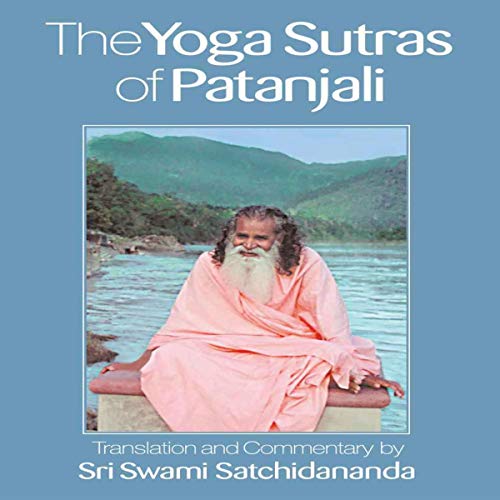
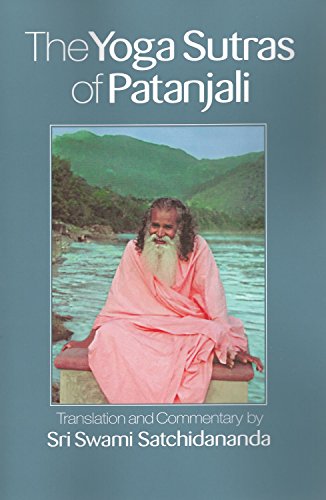
Tonight I will be focusing on Sutra No. 5 from book one (which is the portion on contemplation) from The Yoga Sūtras of Patañjali. They are a collection of 196 Sanskrit sutras (aphorisms) on the theory and practice of yoga. The Yoga Sutras were compiled sometime between 500 BCE and 400 CE by the sage Patanjali in India who synthesized and organized knowledge about yoga from much older traditions.
Best translated to English it read...”There are five kinds of mental modification that are either painful or painless.”
Some thoughts bring us pain. Others do not. A good way to look at them as either being selfish or selfless thoughts. And if you’re thinking….I thought the whole point of the Sutras was to quiet the mind, remember this is number 5 out of 196. And while we try, this is the beginning and it takes time. So in book one, we’re learning and becoming an analyst of our mind….silently watching. This is part of the process. Books two, three and four will deal with Practice, Accomplishment and Absoluteness, respectively). So for know we simply acknowledge our thoughts and training us to have selfless thoughts.
In 2015, 16.1 million Americans reported experiencing major depression during the previous year, often struggling to function while grappling with crippling darkness and despair.
There’s an arsenal of treatments at hand, including talk therapy and antidepressant medications, but what’s depressing in itself is that they don’t work for every patient.
“Many people don’t respond to the frontline interventions,” said Benjamin Shapero, an instructor in psychiatry at Harvard Medical School (HMS) and a psychologist at Massachusetts General Hospital’s (MGH) Depression Clinical and Research Program. “Individual cognitive behavioral therapy is helpful for many people; antidepressant medications help many people. But it’s also the case that many people don’t benefit from them as well. There’s a great need for alternative approaches.”
In recent decades, public interest in mindfulness meditation has soared. Paralleling, and perhaps feeding, the growing popular acceptance has been rising scientific attention. The number of randomized controlled trials — the gold standard for clinical study — involving mindfulness has jumped from one in the period from 1995‒1997 to 11 from 2004‒2006, to a whopping 216 from 2013‒2015, according to a recent article summarizing scientific findings on the subject.
Studies have shown benefits against an array of conditions both physical and mental, including irritable bowel syndrome, fibromyalgia, psoriasis, anxiety, depression, and post-traumatic stress disorder. But some of those findings have been called into question because studies had small sample sizes or problematic experimental designs. Still, there are a handful of key areas — including depression, chronic pain, and anxiety — in which well-designed, well-run studies have shown benefits for patients engaging in a mindfulness meditation program, with effects similar to other existing treatments.
“There are a few applications where the evidence is believable. But the effects are by no means earth-shattering,” Desbordes said. “We’re talking about moderate effect size, on par with other treatments, not better.
The name comes from the Sanskrit words vṛkṣa (वृक्ष) meaning “tree”, and āsana (आसन) meaning “posture”.
History of Tree Pose
A 7th-century stone carving in Mahabalipuram appears to contain a figure standing on one leg, perhaps indicating that a pose similar to vrikshasana was in use at that time. It is said that sadhus disciplined themselves by choosing to meditate in the pose.
The pose is described in the 17th century Gheraṇḍa Saṃhitā.
Description of Tree Pose
From Tadasana, weight is shifted to one leg, for example, starting with the left leg. The entire sole of the foot remains in contact with the floor. The right knee is bent and the right foot placed on the left inner thigh, or in half lotus position. In either foot placement, the hips should be open, with the bent knee pointing towards the side. With the toes of the right foot pointing directly down, the left foot, center of the pelvis, shoulders and head are all vertically aligned. Hands are typically held above the head either pointed directly upwards and unclasped, or clasped together in anjali mudra. The asana is typically held for 20 to 60 seconds, returning to tadasana while exhaling, then repeating standing on the opposite leg.
Benefits of Tree Pose (Vrikshasana)
Improves balance and stability in the legs.
Strengthens the ligaments and tendon of the feet.
Strengthens and tones the entire standing leg, up to the buttocks.
Assists the body in establishing pelvic stability.
Strengthen the bones of the hips and legs due to the weight-bearing nature of the pose.
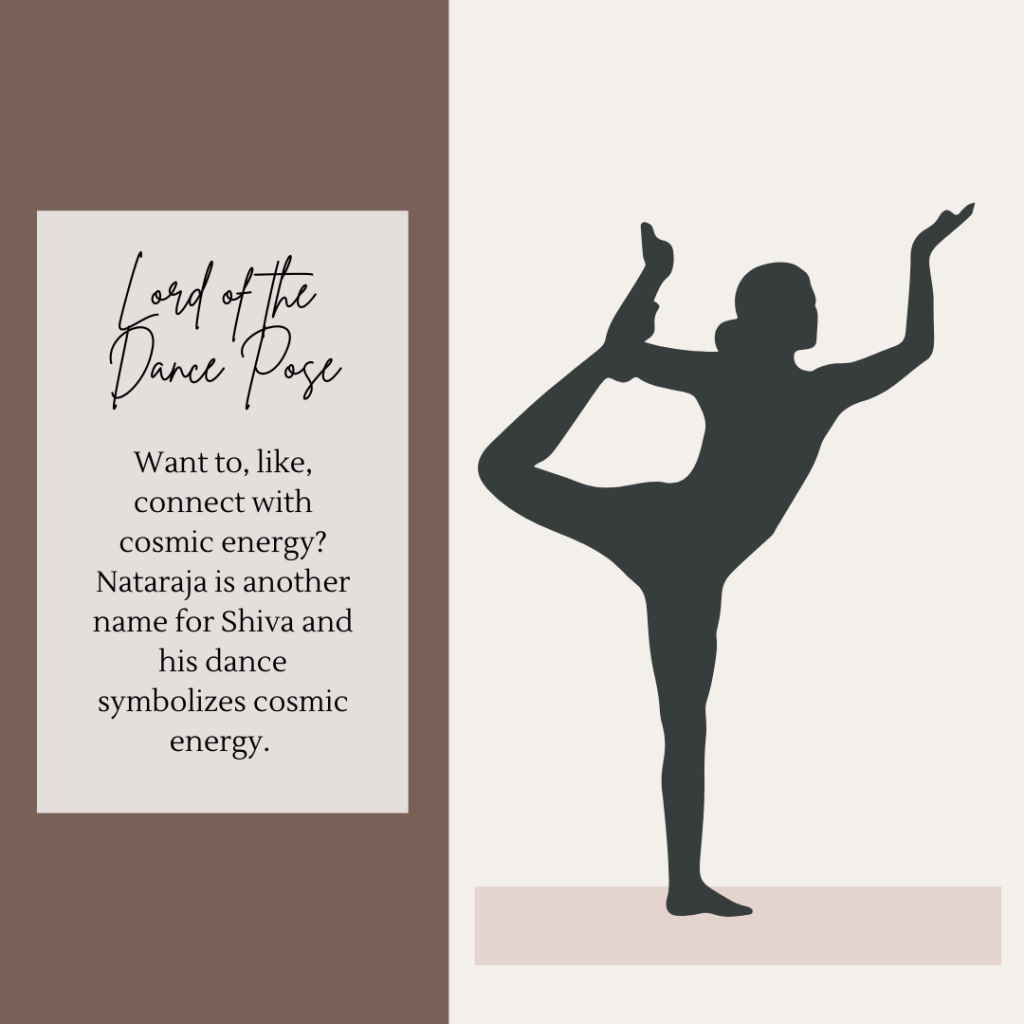
Connect with cosmic energy with Lord of the Dance Pose. Lord of the Dance Pose or Dancer Pose is a standing, balancing, back-bending asana in modern yoga as exercise. It is derived from a pose in the classical Indian dance form Bharatnatyam, which is depicted in temple statues in the Nataraja Temple, Chidambaram.
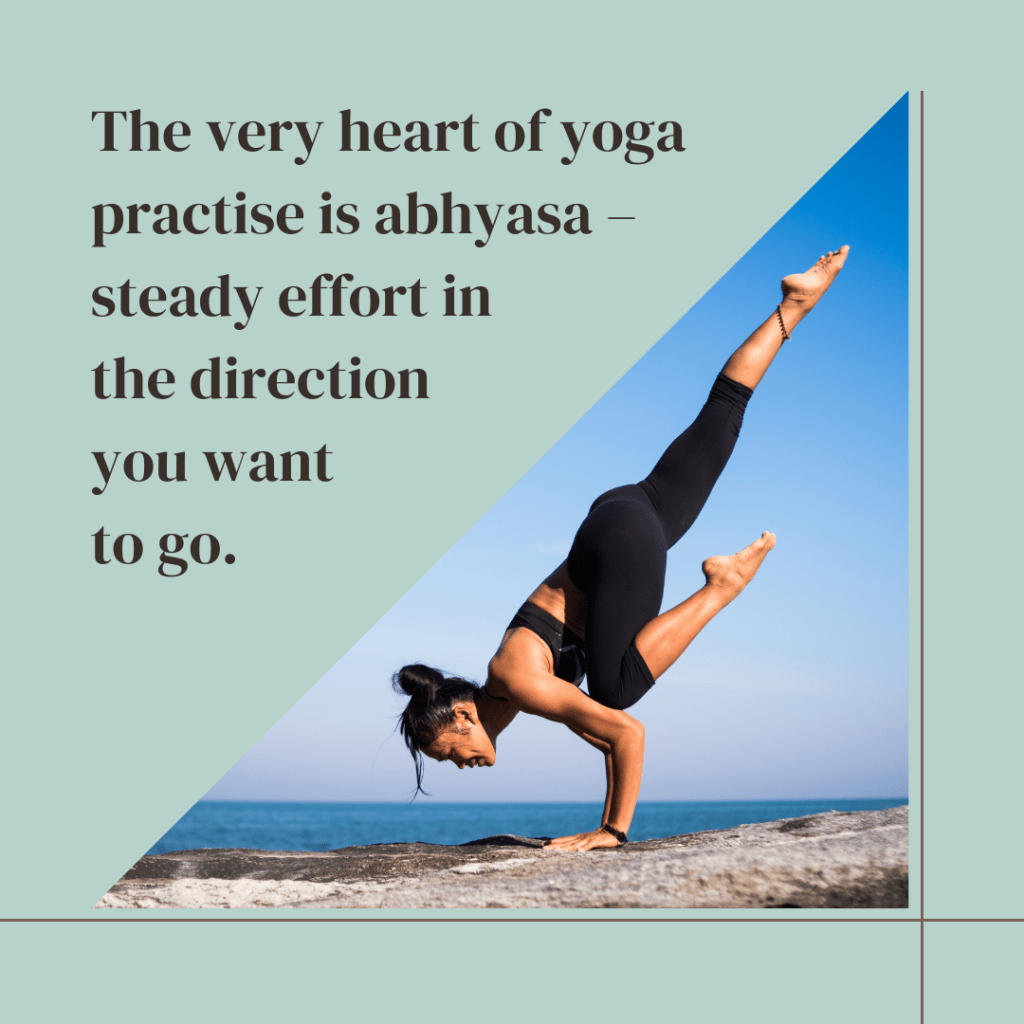
Take some time each morning to ground yourself and reminds yourself of the direction in which you wish to go. A simple journal can be helpful. You can also use that same journal when you go to bed to reflect on the day.
Take some time each morning to ground yourself and reminds yourself of the direction in which you wish to go. I simple journal can be helpful. You can also use that same journal when you go to bed to reflect on the day.
Yoga is much more than the physical movement of our bodies on the yoga mats. Yoga also offers us insights into our motivations, our desires and the ways in which we think and feel about ourselves. We can broaden our experience of yoga by exploring yoga philosophy and mythology. This approach is called Jnana (NYAH-nah) Yoga. The Sanskrit word jnana means wisdom and jnana yoga means the yoga of wisdom. In our lives as yoga practitioners, we can cultivate an intelligence of both our bodies and our minds. Wisdom can be found in every corner, whether we are moving on our mats, practicing meditation on a cushion or reading ancient texts. Yoga is wisdom.
from…Yoga 365 – Daily Wisdom for Life on and off the Mat
Connect with cosmic energy with Lord of the Dance Pose. Lord of the Dance Pose or Dancer Pose is a standing, balancing, back-bending asana in modern yoga as exercise. It is derived from a pose in the classical Indian dance form Bharatnatyam, which is depicted in temple statues in the Nataraja Temple, Chidambaram.
The name comes from the Sanskrit words vṛkṣa (वृक्ष) meaning “tree”, and āsana (आसन) meaning “posture”.
History of Tree Pose
A 7th-century stone carving in Mahabalipuram appears to contain a figure standing on one leg, perhaps indicating that a pose similar to vrikshasana was in use at that time. It is said that sadhus disciplined themselves by choosing to meditate in the pose.
The pose is described in the 17th century Gheraṇḍa Saṃhitā.
Description of Tree Pose
From Tadasana, weight is shifted to one leg, for example, starting with the left leg. The entire sole of the foot remains in contact with the floor. The right knee is bent and the right foot placed on the left inner thigh, or in half lotus position. In either foot placement, the hips should be open, with the bent knee pointing towards the side. With the toes of the right foot pointing directly down, the left foot, center of the pelvis, shoulders and head are all vertically aligned. Hands are typically held above the head either pointed directly upwards and unclasped, or clasped together in anjali mudra. The asana is typically held for 20 to 60 seconds, returning to tadasana while exhaling, then repeating standing on the opposite leg.
Benefits of Tree Pose (Vrikshasana)
Improves balance and stability in the legs.
Strengthens the ligaments and tendon of the feet.
Strengthens and tones the entire standing leg, up to the buttocks.
Assists the body in establishing pelvic stability.
Strengthen the bones of the hips and legs due to the weight-bearing nature of the pose.

















 Inspired Life