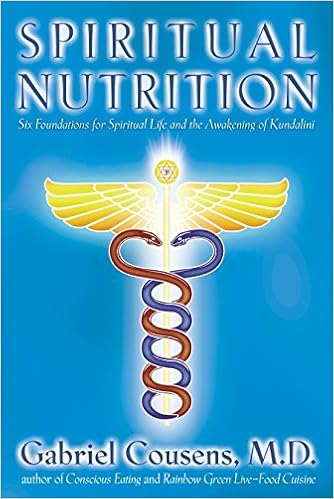
Spiritual Nutrition

Spiritual Nutrition: Six Foundations for Spiritual Life and the Awakening of Kundalini

This recently added to my library.  And I’m glad I did.

When we eat, can we feed the soul as well as the body? Can a diet have an impact on spirituality? Spiritual Nutrition empowers readers to develop personal diets that are appropriate to their lifestyles and spiritual practices. Drawing on 14 years of clinical experience and research, Dr. Gabriel Cousens discusses nutritional issues that can help answer these questions, including raw vs. cooked food; high vs. low protein; the concepts of assimilation and fasting; alkaline–acid balance; attitudes about food; nutrients, energy, and structure building.

In addition, Cousens shares his new dietary system of “spiritual nutrition” that is based on the relationship that the color of the food has to corresponding colors of the human chakra system, hence, the “rainbow diet.” For true nourishment, he strongly promotes the connection of diet to meditation, fellowship, wisdom, and love.

Gabriel Cousens is the author of seven internationally acclaimed books including Spiritual Nutrition and Creating Peace by Being Peace. Known worldwide as a spiritual teacher and the leading expert in live, plant-source nutrition, Dr. Cousens functions as a holistic physician, psychiatrist, family therapist, and cutting edge researcher on healing diabetes naturally.

He holds an M.D. from Columbia Medical School, a doctorate in homeopathy, and diplomas in Ayurveda, clinical acupuncture, and holistic medicine. His multi-cultural background as an ordained rabbi, an acknowledged yogi, and a four-year Native American sundancer, adds insight to his “whole-person enlightenment” teachings.

Dr. Cousens is the founder and director of the Tree of Life Foundation and the Tree of Life Rejuvenation Center, an innovative holistic retreat center for the renewal of body, mind, and spirit, based in Patagonia, Arizona. In his book, There Is A Cure For Diabetes, Dr. Cousens presents his rejuvenation center’s program for reversing diabetes naturally.

Spiritual Nutrition: Six Foundations for Spiritual Life and the Awakening of Kundalini

Reiki – Healing Science – Healing Energy

Reiki is the Japanese word for Universal Life Force Energy. When the ‘Rei’ and ‘Ki’ are broken down into their two component parts, the Kanji (Japanese alphabet) definition for Rei is universal, transcendental spirit, mysterious power, essence. Ki is described as the vital life force energy, very similar to the Chi of Chinese acupuncture, Light to Christians, and Bioplasmic Energy to Russian researchers.
We all have Reiki energy (Universal Life Force Energy), for it is our birth right. What makes Reiki different from other healing methods, is the attunement (Also known as the initiation) process which the student experiences in the various levels of Reiki classes. Anyone can lay their hands on another person and help accelerate the healing process by transferring magnetic energy. A person who has been through the process of Reiki attunements however has experienced a very ancient technology for fine tuning the physical and etheric bodies to a higher vibratory level. In addition, certain of the energy centres, also known as chakras, are opened to enable the person to channel (And vibrate) higher amounts of Universal Life Force Energy.

Reiki is never sent, it is drawn through the channel. For example, If I lay my hands on you to do a treatment, you will draw appropriate amounts of energy to which ever areas of your body need it. I am never drained in the process, as I too am treated as I “Give” a treatment. The energy enters at my crown chakra and passes through the upper energy centres to my heart and solar plexus. The rest then passes through my arms and hands to your body. I am thus never drained in the process, as a certain

via Reiki- Healing Science — Reiki energy

1585426504

Energy Medicine 

146547935X

Science of Yoga

When Science Meets Mindfulness

Intriguing article from the Harvard Gazzette

Researchers study how it seems to change the brain in depressed patients

BY Alvin PowellHarvard Staff Writer

DATEApril 9, 2018SHARE 

TRENDING

  1. Can knowing someone of a different race early in life make you more liberal?
  2. ‘Happiness scholar’ cites three ways to start healing rifts
  3. Good genes are nice, but joy is better
  4. COVID-19 vaccine protects mothers — and their newborns
  5. Supreme Court defers decision on reviewing admissions case

First of two parts

In 2015, 16.1 million Americans reported experiencing major depression during the previous year, often struggling to function while grappling with crippling darkness and despair.

There’s an arsenal of treatments at hand, including talk therapy and antidepressant medications, but what’s depressing in itself is that they don’t work for every patient.

“Many people don’t respond to the frontline interventions,” said Benjamin Shapero, an instructor in psychiatry at Harvard Medical School (HMS) and a psychologist at Massachusetts General Hospital’s (MGH) Depression Clinical and Research Program. “Individual cognitive behavioral therapy is helpful for many people; antidepressant medications help many people. But it’s also the case that many people don’t benefit from them as well. There’s a great need for alternative approaches.”

Shapero is working with Gaëlle Desbordes, an instructor in radiology at HMS and a neuroscientist at MGH’s Martinos Center for Biomedical Imaging, to explore one alternative approach: mindfulness-based meditation.

In recent decades, public interest in mindfulness meditation has soared. Paralleling, and perhaps feeding, the growing popular acceptance has been rising scientific attention. The number of randomized controlled trials — the gold standard for clinical study — involving mindfulness has jumped from one in the period from 1995‒1997 to 11 from 2004‒2006, to a whopping 216 from 2013‒2015, according to a recent article summarizing scientific findings on the subject.

Studies have shown benefits against an array of conditions both physical and mental, including irritable bowel syndrome, fibromyalgia, psoriasis, anxiety, depression, and post-traumatic stress disorder. But some of those findings have been called into question because studies had small sample sizes or problematic experimental designs. Still, there are a handful of key areas — including depression, chronic pain, and anxiety — in which well-designed, well-run studies have shown benefits for patients engaging in a mindfulness meditation program, with effects similar to other existing treatments.

“There are a few applications where the evidence is believable. But the effects are by no means earth-shattering,” Desbordes said. “We’re talking about moderate effect size, on par with other treatments, not better.

Continued….

https://news.harvard.edu/gazette/story/2018/04/harvard-researchers-study-how-mindfulness-may-change-the-brain-in-depressed-patients/

Your Daily Buddha

You are posed for flight! The actions you take begin with the thoughts that you make. Using intention in your daily practice helps guide your projectory and helps you find your power and balance. It is an ongoing process that can begin on the mat and then taken into your day.

1452145008

Yoga 365

1585423246

365 Yoga (Meditations)

Your Daily Buddha

This image has an empty alt attribute; its file name is image.png

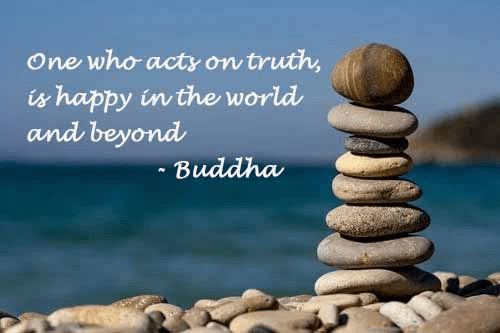
The Buddha (also known as Siddhartha Gotama or Siddhārtha Gautama) was a philosopher, mendicant, meditator, spiritual teacher, and religious leader who lived in Ancient India (c. 5th to 4th century BCE). He is revered as the founder of the world religion of Buddhism, and worshiped by most Buddhist schools as the Enlightened One who has transcended Karma and escaped the cycle of birth and rebirth. He taught for around 45 years and built a large following, both monastic and lay. (wiki)

To learn more:

The Heart of the Buddha’s Teaching: Transforming Suffering into Peace, Joy, and Liberation 

This image has an empty alt attribute; its file name is 51On1f8sWJL._SX323_BO1,204,203,200_.jpg

Your Daily Buddha – Deep Dive into Tree Pose

The name comes from the Sanskrit words vṛkṣa (वृक्ष) meaning “tree”, and āsana (आसन) meaning “posture”.

History of Tree Pose

A 7th-century stone carving in Mahabalipuram appears to contain a figure standing on one leg, perhaps indicating that a pose similar to vrikshasana was in use at that time. It is said that sadhus disciplined themselves by choosing to meditate in the pose.

The pose is described in the 17th century Gheraṇḍa Saṃhitā.

Description of Tree Pose

From Tadasana, weight is shifted to one leg, for example, starting with the left leg. The entire sole of the foot remains in contact with the floor. The right knee is bent and the right foot placed on the left inner thigh, or in half lotus position. In either foot placement, the hips should be open, with the bent knee pointing towards the side. With the toes of the right foot pointing directly down, the left foot, center of the pelvis, shoulders and head are all vertically aligned. Hands are typically held above the head either pointed directly upwards and unclasped, or clasped together in anjali mudra. The asana is typically held for 20 to 60 seconds, returning to tadasana while exhaling, then repeating standing on the opposite leg.

Benefits of Tree Pose (Vrikshasana)

  • Improves balance and stability in the legs.
  • Strengthens the ligaments and tendon of the feet.
  • Strengthens and tones the entire standing leg, up to the buttocks.
  • Assists the body in establishing pelvic stability.
  • Strengthen the bones of the hips and legs due to the weight-bearing nature of the pose.

146547935X

Science of Yoga

1585426504

Energy Medicine 

B07414752B

Vitamin B Complex – Vegetarian

B00JGCBGZQ

Vitamin D – Non GMO and Gluten Free

Eat Pray Love….by Elizabeth Gilbert

1623158281

Chakra Healing 

B07T2K6V8K

Boho Yoga Pants

Daily Buddha

PEACEFUL WARRIOR POSE (VIPARITA VIRANHADRASANA)

Finding space is not always easy – sometimes you have to strive for it like a warrior. Standing steadily in Viparita Viranhasrasana, the sanskrit name for Peaceful Warrior Pose or Reverse Warrior Pose, your legs are spread apart with your front knee bent and your back foot fully rooted to the ground. Arch your torso back fully extending one arm and resting your other hand on your back leg. With your lower body leaning forward while your upper body leans back, you embody the physical process of give and take – of balance seeking. Finding peace often entails finding a balance the aggressive and receptive parts of ourselves. Be a warrior for peace. Be firm in your resolve and open to receive.

from Yoga 365, Daily Wisdom for Life, On and Off the Mat

1452145008

Yoga 365

1585423246

365 Yoga (Meditations)

B089YWB4RD
YY

Yoga Starter Kit